
Digitally Printed Tiles: Modern Designs, Benefits & Ideas for Ontario Homes
Introduction
If you’ve browsed a tile showroom recently, you’ve probably noticed how difficult it can be to tell real stone or wood apart from tile. That’s largely down to digital printing technology, which has improved significantly over the past several years and changed what’s possible on a standard porcelain or ceramic tile.
Digitally printed tiles aren’t new, but the quality and detail available now go well beyond what older manufacturing methods could produce. This article covers what these tiles actually are, how they’re made, and where they tend to work well in a real Ontario home kitchens, bathrooms, entryways, basements, and beyond. We’ll also get into the practical side: cleaning, durability, what to ask before buying, and how to choose a pattern that will still suit your home years from now.digital print tiles
What Are Digitally Printed Tiles?
In simple terms, a digitally printed tile is a ceramic or porcelain tile where the surface design colour, pattern, and texture has been applied using inkjet printing rather than traditional glazing or hand-painting methods. The process is similar to printing a high-resolution photograph, except the surface is a ceramic tile body, and the design is fired at high heat so it becomes a permanent part of the tile rather than a coating on top of it.
Older manufacturing methods relied on stencils or rollers, which limited how much detail or variation could appear across a run of tiles — repeating patterns were often noticeable if you looked closely. Digital printing removes much of that limitation. A single tile can carry a considerable amount of visual detail: fine stone veining, natural-looking wood grain, or a precise geometric pattern with sharp, clean lines.
That’s the core idea behind the category. It’s what allows digitally printed tiles to closely resemble materials like marble, travertine, concrete, and hardwood, while also making more artistic or custom patterns commercially practical in ways that weren’t cost-effective before.
How digital print tiles Creates Detailed Designs
It’s worth understanding the process, since it explains a lot about the finished result. Manufacturers start with a high-resolution image either based on a real material or designed digitally and apply it to the tile surface using industrial inkjet printers built for ceramics. These printers lay down ceramic-based inks in very fine layers, which is what allows for such detailed patterns.
Because the design is applied digitally rather than through a repeating stencil, manufacturers can introduce natural-looking variation between tiles within the same batch. This is particularly useful when replicating materials like natural stone, where no two pieces are identical. After printing, the tiles are fired, which bonds the pattern into the surface so it isn’t a coating or film that can wear away over time.
This technology has also supported the growth of large-format tile, where detailed patterns such as continuous marble veining can run across a bigger surface with fewer visible seams. Digital printing is one of the developments that has made this level of detail on larger tiles more achievable, alongside other advances in manufacturing and slab production.
Why Homeowners Are Considering Printed Tiles
There are a few practical reasons this category has grown in popularity across Ontario and the rest of Canada. Cost is one factor — natural materials like marble or reclaimed wood often come with higher expense and more involved sourcing, particularly for larger areas like a full kitchen floor. Digitally printed tile offers homeowners a way to achieve a similar visual effect, often with more consistency across a finished project.
Flexibility is another consideration. In a smaller condo renovation in Toronto, or an older home in a city like Kingston or Hamilton with existing structural considerations, tile can offer more practical options than solid stone slabs in certain situations. Porcelain, in particular, is a common choice where weight or installation constraints make it a more suitable option — though this depends on the specific product and project.
Design trends also move quickly, and because digital printing allows manufacturers to introduce new patterns without retooling entire production lines, the range of modern tile designs available to Ontario homeowners has expanded considerably in recent years.
Digitally Printed Tile Ideas for Ontario Kitchens
Kitchens are often where homeowners start exploring printed tile, since there’s a significant amount of visible tile surface involved from flooring to backsplash and kitchens tend to see more daily wear than most other rooms.
Backsplashes are one of the most common applications. A digitally printed tile backsplash allows homeowners to introduce colour or pattern without committing to it across a larger area. Options like a subtle patterned print, a marble-look tile, or a matte concrete finish can noticeably change the character of a kitchen.
Flooring is another popular choice. Wood-look porcelain has become a common flooring option for Ontario kitchens, offering the visual warmth of hardwood while generally standing up well to the wear that happens near sinks and high-traffic areas a relevant consideration given Ontario’s winter conditions, with salt, slush, and moisture regularly tracked indoors.
Kitchen islands finished in a printed tile pattern have also become more common in newer builds and open-concept renovations, where the island functions as a prominent visual feature in the room.
In smaller kitchens, such as those in many condos, lighter printed tile — a pale stone-look or soft concrete tone can help the space feel more open while still introducing a considered design element.
Using Digital Print Tiles in Bathroom Renovations
Bathrooms are another common application, with moisture management and visual consistency across surfaces being key considerations.
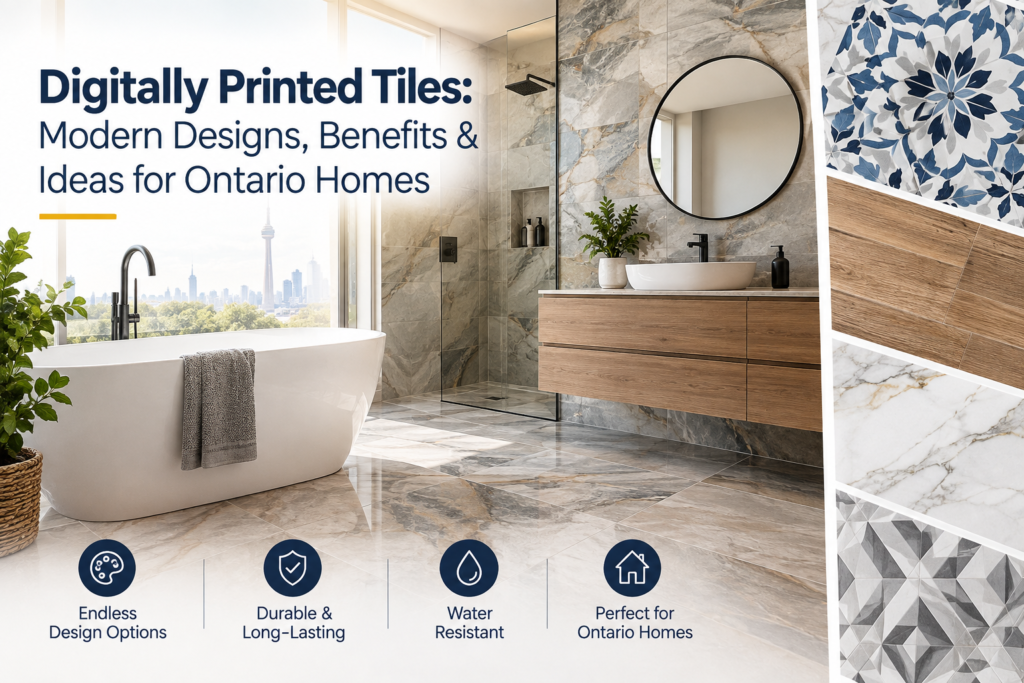
Large-format marble-look porcelain has become a popular choice for shower walls and floors in Ontario bathroom renovations. It offers a similar visual effect to natural marble, generally without the sealing and maintenance that natural stone requires in a wet environment. Porcelain is widely used in bathrooms because it tends to manage moisture well when properly installed.
Feature walls behind a vanity or tub are another approach worth considering. A single wall finished in a textured or patterned printed tile can serve as a focal point, particularly when paired with simpler fixtures and lighting elsewhere in the room.
Basement bathrooms, which are common in many Ontario homes with finished basements, are also a reasonable fit for printed tile flooring, as porcelain generally performs well in the cooler, sometimes damper conditions typical of below-grade spaces.
Modern Tile Designs for Contemporary Ontario Homes
A few consistent themes come up when discussing modern tile designs Ontario homeowners are choosing.
Large-format tile with minimal grout lines is a common preference, as fewer visible seams tends to create a cleaner, more contemporary appearance.
Concrete-look tile has grown in popularity among homeowners drawn to an industrial or minimalist aesthetic, without the maintenance that comes with actual poured concrete, which can crack, stain, and requires ongoing sealing.
Terrazzo-inspired patterns, now achievable through digital printing, have also seen renewed interest offering a nod to a material that was common in past decades, without the cost associated with an actual poured terrazzo floor.
Matte finishes have become more common in new builds and renovations as well, partly because they tend to show fewer fingerprints and water spots than glossy finishes, which is a practical consideration in busy households.
In older Ontario homes including century homes in established neighbourhoods across cities like Toronto, London, and Kitchener printed tile also offers a way to introduce a traditional-style pattern, such as an encaustic-inspired cement tile print, in an entryway or mudroom, complementing the home’s character without relying on more fragile original materials.
Where Else Can You Use Digitally Printed Tiles?
Entryways and mudrooms see considerable wear in Ontario homes due to seasonal salt, slush, and moisture. A durable printed tile floor in this area can handle regular use while contributing to the overall design of the space.
Feature walls in living spaces are another application, often used as an alternative to paint or wallpaper — commonly behind a fireplace or media wall.
Basements are a frequent candidate for printed tile flooring in basement renovation projects, as porcelain generally handles below-grade humidity reasonably well and can give a finished space a more cohesive appearance.
Laundry rooms also benefit from tile’s moisture and spill resistance, with a patterned floor offering a practical way to add some visual interest to a utility space.
Covered porches or sunrooms may be suitable for certain frost-rated printed tile products, though this varies by manufacturer. It’s important to confirm a specific product’s rating before using it in a semi-exterior or unheated space.
Benefits of Digitally Printed Tiles
Design flexibility. Because the pattern is printed rather than physically formed into the tile, manufacturers can offer a wide range of colours, patterns, and material-inspired designs.
Detailed patterns. High-resolution printing allows for fine detail, including wood grain texture, stone-like veining, and precise geometric or decorative motifs.
Consistency across larger projects. Digitally printed tile batches often provide more visual consistency than natural stone, which can vary significantly from slab to slab.
A wide range of decorative and custom designs. Digital printing has made more artistic and custom tile patterns commercially practical, expanding the decorative options available to homeowners.
Generally straightforward maintenance. Most digitally printed porcelain and ceramic tiles can be cleaned with regular sweeping or vacuuming and occasional mopping using a pH-neutral cleaner, and typically don’t require the sealing that natural stone often needs.
Durability suited to everyday use. Porcelain tile is a dense, hard-wearing material, which is one reason it’s commonly used in high-traffic areas such as kitchens and entryways. Durability still depends on the specific product and installation quality, so it’s worth asking your supplier about the tile’s PEI rating a standard measure of surface wear resistance — for any flooring application.
Things to Consider Before Choosing Printed Tiles
Lighting affects how a pattern appears. A tile that looks a certain way under showroom lighting may read differently in a room with limited natural light or warm artificial lighting. Viewing a sample in the actual space, at different times of day, is a useful step before deciding.
Bold patterns represent a bigger design commitment. A striking pattern can work well, but is generally harder to change later than a more neutral option. For larger surfaces, many homeowners choose a more neutral printed tile and reserve bolder patterns for smaller areas, such as a backsplash or powder room, where updating the design later is more manageable.
Grout colour affects the overall look. The same tile can appear noticeably different depending on whether it’s installed with a matching grout, for a more seamless appearance, or a contrasting grout, which highlights the tile layout.
Not all printed tile is rated for the same application. Some products are designed specifically for walls and aren’t intended for flooring use. It’s important to check the manufacturer’s specifications for the tile’s intended application.
Slip resistance is worth confirming, particularly for bathroom floors, shower floors, and entryways where moisture is common, as this can vary between products with a similar appearance.
How to Choose the Right Tile Design for Your Home
Start with existing or planned elements that won’t change. Cabinetry, countertops, and major fixtures are typically more costly and difficult to replace than tile, so selecting a tile that complements these elements tends to produce a more cohesive result.
Consider the longevity of the design. Highly trend-driven patterns may feel dated sooner than more classic options. Homeowners planning to stay in their home long-term, or renovating with future resale in mind, may find that a more traditional stone-look or wood-look printed tile has broader lasting appeal.
Think about flow between connected spaces. In open-concept Ontario homes, where kitchen, dining, and living areas often share sightlines, using consistent or complementary tile flooring across these areas can help create a more unified main floor.
Review physical samples before finalizing a decision. Because printed tile designs vary between manufacturers, viewing an actual sample in your home’s lighting, alongside existing finishes, is the most reliable way to confirm the design will work as expected.
Professional Tile Installation and Home Renovation in Ontario
Proper installation plays a significant role in how a tile ultimately performs. Subfloor preparation, appropriate adhesive selection, correct spacing, and careful attention to transitions between rooms all affect the finished result — particularly with large-format tile, which requires a flat, well-prepared surface to avoid lippage, where tile edges sit unevenly.
For kitchen and bathroom installations specifically, proper waterproofing and substrate preparation around showers, tubs, and sinks is an important step to get right from the outset.
For larger projects — such as a full kitchen renovation, bathroom remodel, or basement renovation involving new tile flooring — working with a contractor who manages both the tile installation and the broader renovation scope can help keep the project coordinated from start to finish.
Frequently Asked Questions
What are digitally printed tiles?
Digitally printed tiles are ceramic or porcelain tiles where the surface pattern is applied using industrial inkjet printing technology, then permanently fired into the tile. This process allows for detailed designs, including realistic imitations of natural stone and wood.
Are digitally printed tiles suitable for kitchens?
Yes. Digitally printed porcelain tile is commonly used for kitchen flooring, backsplashes, and islands, largely due to its durability and relatively low maintenance requirements.
Can digital print tiles be used in bathrooms?
Yes, they’re a common choice for bathroom walls, floors, and shower surrounds. Porcelain generally manages moisture well, though it’s important to confirm the product is rated for wet-area use and that installation includes proper waterproofing.
Are printed tiles easy to clean?
Most digitally printed tiles are cleaned with regular sweeping or vacuuming and occasional mopping using a pH-neutral cleaner, and typically don’t require sealing.
How do I choose a printed tile design?
Consider elements in the room that won’t easily change, such as cabinetry or fixtures, and select a tile that complements them. It also helps to think about how long the design will feel relevant, and to review samples in your home’s lighting before deciding.
Are digitally printed tiles suitable for Canadian homes?
Porcelain tile is commonly used in Canadian homes and is generally well-suited to everyday conditions, including seasonal moisture and salt exposure. As with any material, it’s worth confirming a specific product’s suitability for its intended location, particularly for exterior or semi-exterior applications.
Do digitally printed tiles require professional installation?
While some smaller projects may be suitable for an experienced DIYer, professional installation is generally recommended, particularly for large-format tile, wet areas such as showers, and projects involving subfloor preparation and waterproofing.
Final Thoughts
Digitally printed tiles have expanded the design options available to homeowners, offering a practical way to achieve a range of looks across kitchens, bathrooms, entryways, and other areas of the home. Whether you’re planning a full renovation or updating a single space, they’re a category worth considering alongside more traditional materials.
If you’re planning a renovation and would like to discuss flooring, tile, or how a project like this fits into your broader plans, our team is available to help you think through the options for your space and budget.